
Avian Anatomy for Artists — The Foot
What bird feet can teach us about drawing with confidence
Many artists find drawing bird feet among the hardest parts of a sketch. They’re the avian equivalent of human hands: full of joints, foreshortening, and expressive little details that can make or break a sketch. It doesn’t help that photo references often ignore the feet with fuzzy focus or hiding them from view. But once you understand how they’re built, bird feet become both fascinating and enjoyable to draw.
There’s extraordinary variety across species—from the webbed paddles of a duck to the diminutive toes of a hummingbird—but in this lesson, we’ll focus on the most common arrangement: three toes forward and one back. This is the perching foot seen in songbirds, doves, hawks, and many others. Learning this structure will help you draw any bird’s feet convincingly.
🪶 This is the second in my series: Avian Anatomy for Artists. Read the first lesson on understanding and drawing the bill here.
The Basics of Structure
Birds use their feet to walk, capture food, swim, and even attract a mate. Even though there is huge diversity in toe arrangement, the feet and legs of birds share one basic plan.
What we often call the “leg” is really the tarsus1. The joint you can see on most birds isn’t the knee (that’s usually hidden by feathers), it’s more like an ankle.
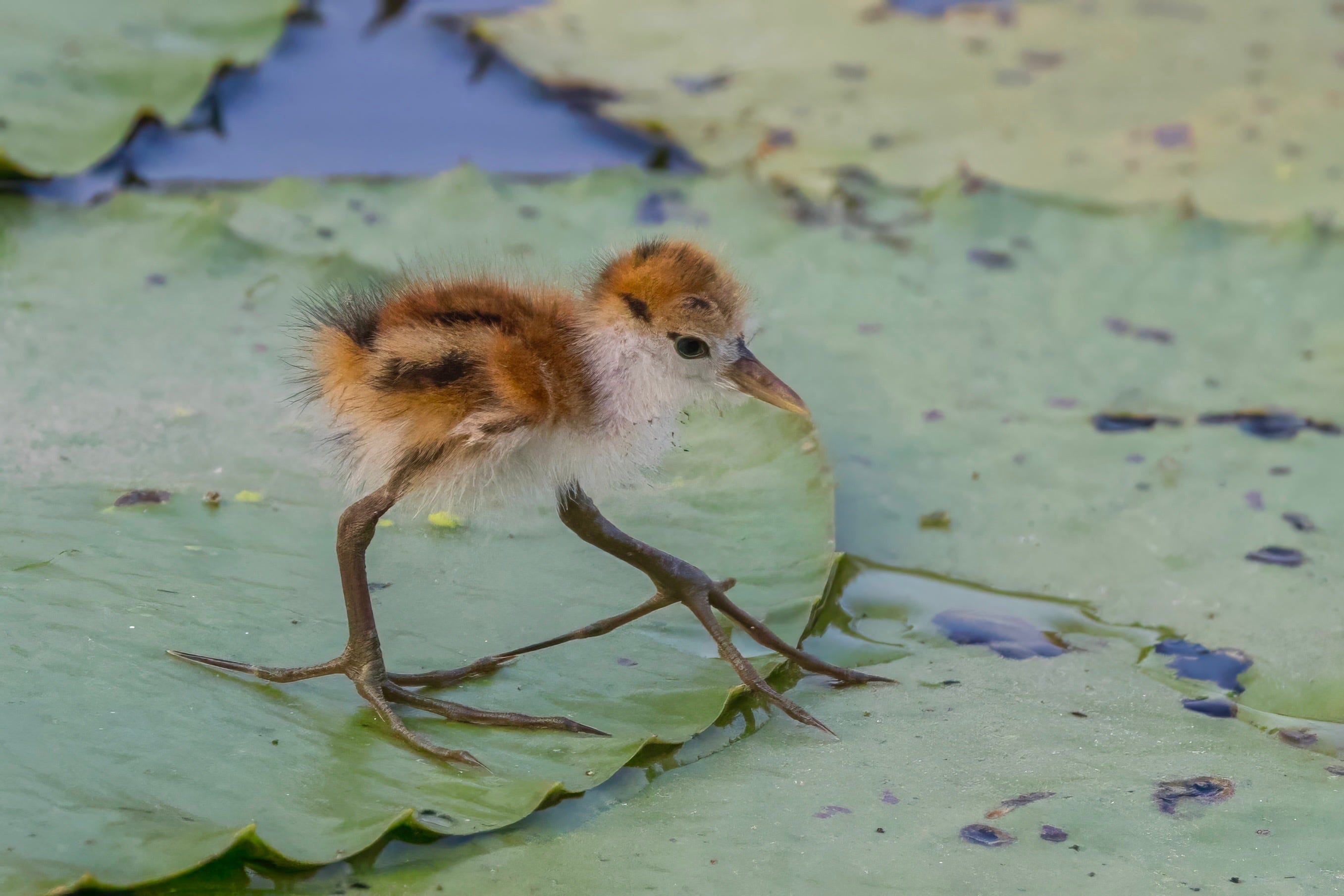
The toes are attached to the front and back of the tarsus. The back toe, the hallux, acts like a thumb, supplying balance and stability. Note that the front toes differ in length: the middle one is longest. Getting those proportions right makes a big difference in realism. Each toe ends with a claw or nail that grows (more or less) from the upper surface of the toe, curving out and down.
Finally, the surface of the foot is covered with scutes and scales—these overlapping plates add both texture and protection. (You won’t need to draw every one of these; it’s enough to hint at their shapes to show the form.)
_chick_Kakadu.jpg)
Why Feet Are So Tricky
Even for an experienced bird artist like me, feet can be deceptively hard to render. They might be small but still full of subtle perspective shifts, and each toe bends at several joints.
Foreshortening: When toes are turned toward or away from you, the shifts in perspective get challenging.
Angle confusion: Feet are surprisingly flexible and getting the angles worked out can be a chore.
Texture overload: Scales, pads, nails—it’s easy to get lost in details.
Poor reference: Photographs often show the feet blurred, obscured, or in poor lighting.
Don’t let these challenges discourage you. The good news is that a little anatomical knowledge, combined with patient observation, solves most of them. The goal isn’t to memorize every part but to see shapes and how angles, balance, and gesture work together.
✨ If this kind of mindful study of birds inspires you, consider joining as an Insider.
You’ll receive a video lesson, a full tutorial, and photo gallery—plus access to the complete Avian Anatomy for Artists series and other resources designed to help you see and draw birds with confidence and joy.
Keep reading with a 7-day free trial
Subscribe to The Painted Redstart to keep reading this post and get 7 days of free access to the full post archives.